Powered by AI.
Run by humans.
NEXIRT is a Las Vegas AI integration studio. We design and build AI agents, client portals, internal tools and websites.
Encrypted in transit · never used for training · reviewed by an engineer · Privacy
One request, from inbox to done.
Follow one sample enquiry through the six layers of a system we build.
All six layers
One system, built around how your team already works.
Six layers, from the channels your customers use to the AWS account it can run in.
Status: Working
Layer 1 of 6 · Channels
An enquiry arrives through your website form.
Forms, email and chat all arrive in one place.
Trace:
channel.receiveStatus: Working
Layer 2 of 6 · Agent
The agent reads it and works out the steps.
It sorts the request and decides which steps to run.
Trace:
agent.routeStatus: Working
Layer 3 of 6 · Knowledge
It pulls the matching service notes and past conversations.
It works from your own documents and history.
Trace:
knowledge.retrieveStatus: Working
Layer 4 of 6 · Tools & systems
It checks CRM, calendar and payments, then drafts a reply.
Tools are the systems you already use, called with the access you grant.
Trace:
tools.crm.lookuptools.calendar.checktools.payments.readtools.email.draftStatus: Working → Draft · needs approval
Layer 5 of 6 · Guardrails
Nothing reaches a customer until a person approves it.
You choose the checks; anything customer-facing waits for a person.
Trace:
guardrail.reviewhuman.approveStatus: Draft · needs approval → Approved
How we keep agents safe →Layer 6 of 6 · Your cloud account
The reply goes out, and every step is logged.
It can run in your AWS account, so the data and the audit log stay yours.
Trace:
channel.sendaudit.writeStatus: Approved → Done · logged
All six layers
One system again.
A custom build starts with a 1–2 week Discovery Sprint: a working prototype and a fixed-price quote.
Status: Done · logged
Talk to an engineer →Example runs: Try another workflow
A web-form enquiry arrives.
Plays through the stack and stops for your approval.
What you can hire us to build.
Start with a conversation, not a contract.
You see a working prototype and a fixed price before you commit to a build.
Talk to an engineer
Tell us the problem. An engineer replies within one business day.
Discovery Sprint
One to two weeks with your team, for a fee agreed up front, ending in a working prototype.
Fixed-price quote
Scope, timeline and one number. The sprint fee counts toward the build.
Build and launch
Weekly previews, then a rehearsed launch with handover docs.
Built by us. Running today.
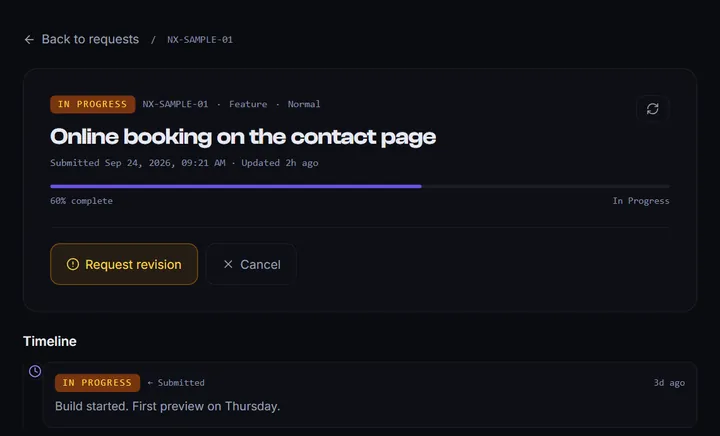
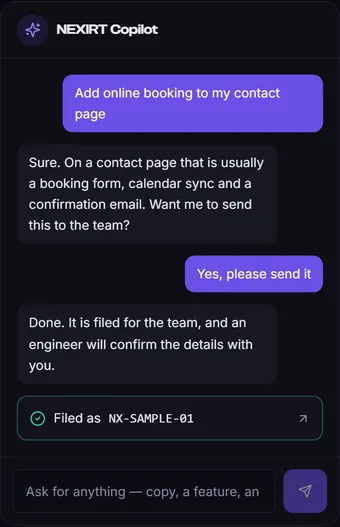
Our client portal, the Copilot above and this website are NEXIRT builds.
See concept studiesSee how it works
Tell the Copilot what you need. Engineers build it, AI does the routine work, and a person approves anything that reaches your customers.

Read the transcript
NEXIRT runs your website and your business email, and gives you one portal for everything in between.
Inside your client portal, tell the NEXIRT Copilot what you need. It drafts a plan and files the request.
Engineers build it. AI does the routine work, and a person approves anything that reaches your customers.
Powered by AI. Run by humans.
Tell us what slows your team down.
Systems can run in your own AWS account, where feasible · Anthropic and AWS Bedrock don't train on your data · How we handle security →